


Absolute dB values are often used as a measure of quality when comparing different impact sound insulation products. In principle, this is correct. Unfortunately, however, not all information available on the market is always reliable; for example, when ‘high impact sound insulation values’ are cited based on testing methods that are unclear or unrealistic, or when an unspecified (absolute) sound insulation value – also in dB – is presented as a (relative) measure of sound improvement.
Did you know that, with an otherwise identical frequency distribution, a sound reduction of approximately 5 dB(A) is subjectively perceived as the volume being halved?
Further information
Impact sound insulation
An additional underlay can prevent sound transmission between the floor covering and the subfloor. Insulation underlays made from mineral sand, PE underlays, cork rolls, XPS or EVA foam are laid beneath the floor covering. When selecting the right insulation mat, you should consider not only the material but also the thickness, as installing the impact sound insulation affects the overall height of the floor.
As the floor covering itself also contributes to sound insulation properties, we have optimised each of our products for its typical application as an underlay for floating-laid pre-finished parquet / pre-finished timber floors / laminate flooring / cork and linoleum pre-finished parquet, so that not only are high impact and footfall sound insulation values achieved, but also a frequency spectrum that is perceived as being as pleasant as possible is ensured.
With our Premiumline products, you can further optimise room acoustics when using a glued installation method.
Vapour barrier
If the floor covering is laid on a mineral substrate, a vapour barrier (PE film) must be installed in addition to the impact sound insulation. The vapour barrier is installed between the subfloor and the impact sound insulation, or is integrated directly into the underlay (e.g. aluminium lamination)
Underfloor heating
Combining impact sound insulation with underfloor heating requires careful planning and selection of materials, as both systems have different requirements and properties. Here are the key points to bear in mind:
- Material compatibility: It is important that these materials do not impair heat conduction too significantly, as the heat must be transferred evenly and efficiently through the floor.
- Thermal conductivity: The thermal conductivity of the impact sound insulation materials must not be too low, as this would otherwise hinder heat transfer from the heating pipes or heating mats to the floor covering. Materials such as cork or certain types of foam can have an insulating effect and thus reduce the effectiveness of the underfloor heating.
- Installation thickness: Insulation that is too thick can impair the heating performance of the underfloor heating system, as the heat cannot be efficiently transferred through the floor.
The thermal resistance of the entire floor structure should not exceed 0.15 m²K/W for water-heated floors. The lower this value, the more suitable the underlay is for use on heated floor surfaces. Products such as topsonic with aluminium lamination, Silence Floor with aluminium lamination or XPS Quick Plus offer excellent thermal conductivity.
Compressive strength
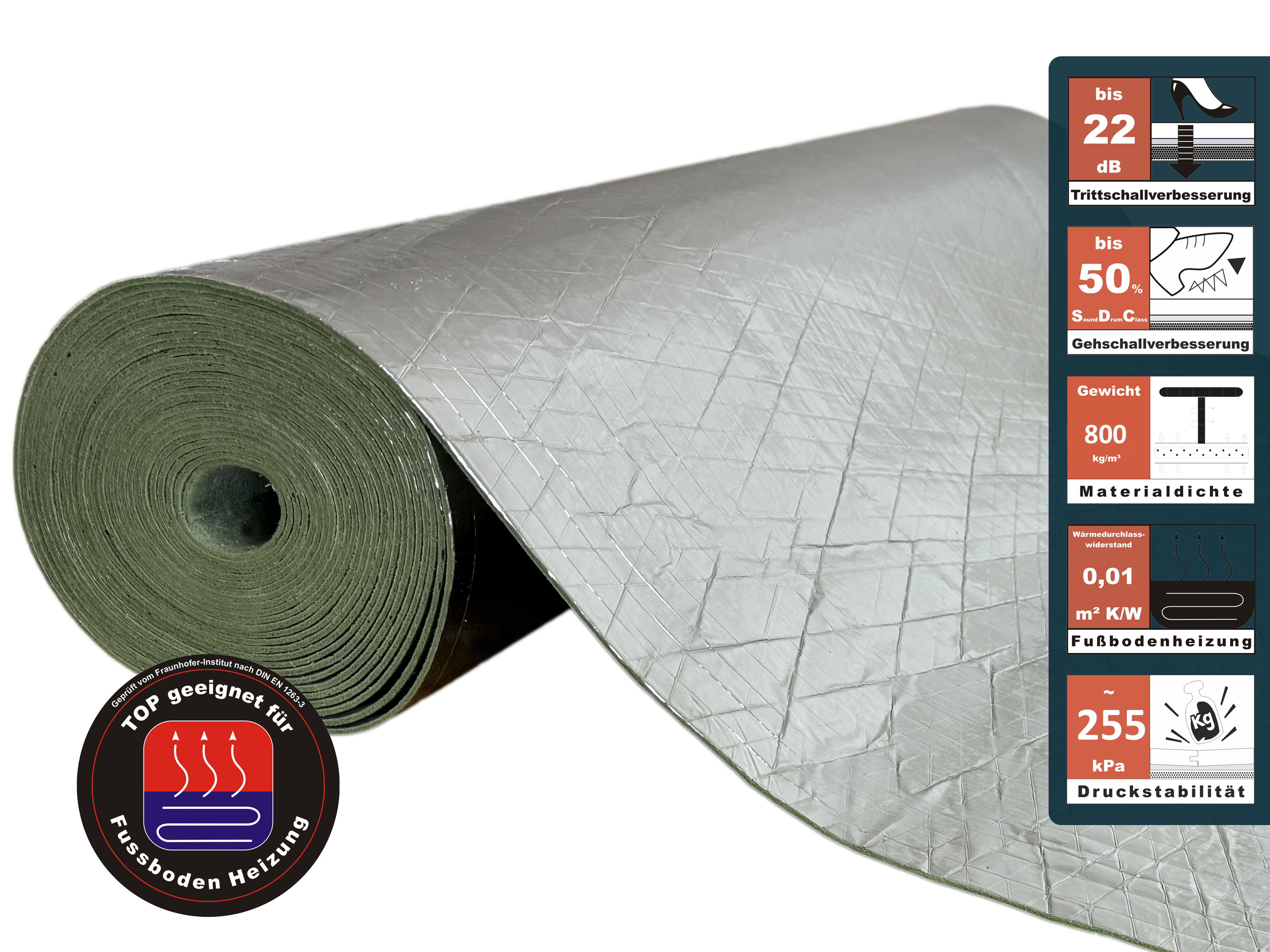
Did you know that many parquet underlays on the market lose a significant amount of their insulating effect over time due to a lack of compressive stability, particularly on floors subject to heavy use? You should therefore always check the long-term compressive stability of the underlay! This is particularly important if, for example, there is heavy furniture in the room; underlays that are too soft place extreme strain on the tongue-and-groove joints of the floor, which can lead to permanent damage to the floor. Particularly in the case of non-glued floors with click systems, we therefore recommend using only pressure-stable underlays with a load-bearing capacity of at least 2 to/m².
In terms of quality, this insulation is in a different league to foam, polystyrene or cork. With uficell® topSonic Acoustic, you get the best impact sound insulation for parquet and laminate flooring. This is because it reduces noise more effectively and conducts heat considerably better when used with underfloor heating.
The heavier the insulation mat, the lower the noise level
The weight of an insulation material is important. The denser or heavier the mat, the less sound penetrates into the rooms below. That is why walking in high heels or on hard rubber soles on tiles laid over a screed is quieter than walking on a laminate floor. Our uficell® topSonic Acoustic is made from natural rubber, which gives the mat its weight. The 10 m² uficell® topSonic Acoustic impact sound insulation mat, at 3 mm thick, weighs a substantial 28 kilograms. It achieves an impact sound reduction of around 22 decibels (dB). In particular, impact sound is reduced by over 30 per cent when uficell® topSonic Acoustic is installed beneath laminate flooring.
Laying the impact sound insulation (with underfloor heating)
In 80 to 90 per cent of cases, impact sound insulation is laid directly onto the screed. It can also be laid on top of existing wooden flooring. Even over underfloor heating and for any other type of floating installation, our uficell® topSonic Acoustic is the best choice. It absorbs the heat and transfers it efficiently to the floor covering. For underfloor heating, use our uficell® topSonic Akustik ALU – this has an aluminium laminate on one side for even better heat transfer. Lay the uncoated side on the subfloor. The aluminium side should face upwards. By sealing the joints with aluminium tape, you can achieve a water column rating of SD 75m. Please note: A vapour barrier film is still mandatory for most laminate flooring manufacturers when using underfloor heating, as well as in any area in contact with the ground or in rooms without a basement.